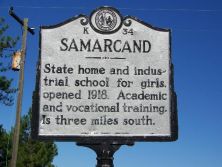
Samarcand Manor
Samarcand Manor, officially the State Home and Industrial School for Girls, was a humane correctional institution for young women established near Eagle Springs by the North Carolina state legislature in 1918. The purpose of the school was to reclaim and train delinquent girls by providing a "homelike place where those who have fallen may find temporary shelter, and under a firm yet kind discipline, begin to live morally." The school, built on 230 acres in Samarcand (named for the Muslim city conquered by Alexander the Great that served as his empire's seat of learning and culture), was one of the first institutions of its type in the South. The original clients were young girls or women who had been convicted of being prostitutes, vagrants, or habitual drunkards or who were guilty of any misdemeanor suggesting that they were "not virtuous." There were no definite terms, but the clients could not be held more than three years and were to be released on good behavior.
Agnes B. MacNaughton became Samarcand's first superintendent, and by 1919 more than 200 women between the ages of 10 and 30 had arrived. In the 1920s the daily program emphasized Bible study, manners, cleanliness, music, nature, and sports in addition to the regular academic subjects. The girls also received vocational training in sewing, weaving, canning, laundry work, and poultry and dairying activities. The program stressed self-reliance and pride in one's work. Between 1928 and 1930 a total of 296 girls were admitted, most between the ages of 12 and 16. By 1930 Samarcand had a hospital and an accredited high school.
In 1931, 16 Samarcand inmates set fire to two dorms and were charged with arson, then a capital crime. While awaiting trial, the girls burned their jail cells. Eight of the 12 involved were eventually sent to prison. Samarcand survived this notorious 1931 incident and other difficulties but was unable to withstand the financial strains of the Great Depression and the siphoning off of staff during World War II. In 1974 the state changed the name of the institution to Samarcand Manor and placed it under the purview of the North Carolina Department of Human Resources, Youth Division. Samarcand became one of five state training schools designed to rehabilitate delinquent children (both male and female) between the ages of 10 and 17. The school shifted its emphasis to treatment and therapy. In the early 2000s Samarcand had approximately 190 clients (40 females and 150 males) and 210 staff members.
References: 
Ida Briggs Henderson, "The Work at Samarcand," The State (4 Apr. 1936).
Lisbeth Parrott, "Samarcand Opens Door of Hope to 1,000th Girl in Tenth Year," Raleigh News and Observer, 7 Oct. 1928.
Samarcand Manor: 50th Anniversary, 1918-1968 (1968).
Additional Resources:
State Home and Industrial School for Girls (Samarcand, N.C.). Biennial report of the Board of Directors and Superintendent of the State Home and Industrial School for Girls, Samarcand Manor, Samarcand, N.C. Samarcand, N.C. [N.C.]: The School. 1926-1938. http://digital.ncdcr.gov/cdm/ref/collection/p16062coll9/id/4894 (accessed May 24, 2013).
"Samarcand." N.C. Highway Historical Marker K-34, N.C. Office of Archives & History. http://www.ncmarkers.com/Markers.aspx?sp=Markers&k=Markers&sv=K-34
McLaurin, Melton Alonza, and Russell, Anne. The Wayward Girls of Samarcand: A true story of the American South. Wilmington, N.C.: Bradley Creek Press. 2012.
Steelman, Ben. "Review - McLaurin, Russell write a gripping yarn." StarNews Media. July 8, 2012. http://www.starnewsonline.com/article/20120708/articles/120709845
Gilkeson, Florence. "Samarkand Makes Case to Stay Open." ThePilot.com. September 24, 2009. http://www2.gosandhills.com/stories/20090925/news/local/20090925Case.html
Image Credits:
Samarcand Building, 1926. Image courtesy of State Archives of North Carolina, call #: N_98_9_187.
"Playtime, children on the wagon." Image courtesy of State Archives of North Carolina, call #: N_98_9_188.
"Our Three Youngest." Image courtesy of State Archives of North Carolina, call#: N_98_9_189.
1 January 2006 | Pleasants, Julian M.


Comments
ellen marcus replied on Permalink
This is poorly researched and written. It's clear Pleasants did not read any of the trial reports of the inhumane abuse these girls suffered. Not only were they whipped, starved, and illegally incarcerated a majority was also sterilized. Talk about rubbing salt in a wound.
Mike Childs replied on Permalink
Thank you, we welcome your comments. I have added links in the Additional Resources to articles discussing some of the issues with Samarcand Manor.
Mike Childs, Government and Heritage Library, State Library of North Carolina.
linda little replied on Permalink
this place should be bulldozed off the face of the earth for the lives it ruined.
I was sent there for "running away" to be with my father, whom my mother had kicked out.
I ran away a total of 1/2 mile up the road, several times to be with my father.
this was my "crime"!
Ihad no representation in juvenile court - the state had to meet their quota of residents, and I was a number.
Had my hands tied to a dental chair and 4 front teeth pulled out, and partial plate put in, so that the school could meet their quota for the year in dental/medical work --
I have been to hell and back -- this was a concentration camp on US SOIL.
Add a comment