October 5, 1751–October 20, 1799
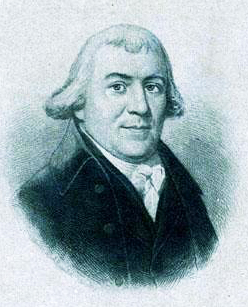
James Iredell Senior was a lawyer, state judge, state attorney general, United States Supreme Court justice, and landowner. He was born at Lewes, in Sussex, England on October 5, 1751. Iredell was the oldest of five sons of Margaret McCulloh and Francis Iredell. His father was a small Bristol merchant who suffered a stroke in the mid-1760s, which prevented him from continuing to work. As a result, young Iredell dropped out of school and acquired a job through the influence of his McCulloh relatives.
In 1768, Iredell was appointed comptroller of customs at Edenton’s Port Roanoke. His yearly salary of thirty pounds was paid directly to his parents, while he lived on an estimated 100 pounds per year in port fees. Iredell was responsible for collecting customs and looking after Henry Eustace McCulloh's properties and other interests. During this time, McCulloh, the collector of Port Roanoke, mainly lived and worked in England. Iredell also created one of his first political essays during this time, “Essay on Religion” (c. 1768). In 1774, McCulloh negotiated the transfer of the collectorship to Iredell. Iredell remained the collector at Port Roanoke until June 1776.
Early Career and Public Service
While working at Port Roanoke, Iredell began studying law under Samuel Johnston and was admitted to the bar in 1771. He also practiced law while handling his customs duties. In 1773, Iredell married Samuel’s sister, Hannah Johnston. By August 16, 1774, Iredell was appointed and receiving commission as Deputy King’s Attorney for Hertford, Perquimans, and Tyrrell counties.
Early on, Iredell believed in reconciliation with Great Britain. While he felt that Parliament had passed numerous acts harmful to the colonists which violated their constitutional rights, he rejected the idea of American independence until around 1776. He tried, through a scholarly use of British history, to demonstrate that the legislature of the parent country and the legislatures of the colonies were entirely independent of one another but united in a common monarch. Eventually, Iredell concluded that there was no hope of Parliament ever placing limits on its authority. After this realization and despite being employed by the British Government at the Port of Roanoke, Iredell became a vocal supporter of revolution and American independence. Essays that Iredell authored to this effect include “To the Inhabitants of Great Britain” (1774), “Principles of An American Whig” (1775), “To His Majesty George the Third,” (1777), and “To the Commissioners of the King of Great Britain for restoring Peace...” (1778).
Supporting the colonists' revolt from England in 1776 cost Iredell considerably when he was disinherited by a wealthy bachelor uncle in the West Indies. However, it also led to Iredell taking a more active role in public affairs. He continued to write political essays for the Patriots. He also accepted a post in 1777 as one of the judges of the Superior Court (Supreme Court) system. One notable case Iredell presided over occurred in November 1778. In that case, Iredell voided a lower-court ruling from Perquimans and Pasquotank Counties which ordered that people who had been manumitted but had been re-enslaved must be sold. However, in December, the state legislature voided Iredell’s ruling by passing a new law. The law officially designated all people who had already been freed and then re-enslaved as legal slaves. Iredell resigned from the courts the following year. He returned to public life in 1779 as attorney general of North Carolina. He served in this role for two years. As attorney general, he pursued legal action against the Loyalists and others who opposed the Revolutionary War effort.
Private Practice and Politics
Iredell returned to private life and his law practice near the end of 1781 but maintained an active interest in politics. According to letters he wrote, Iredell identified as a political conservative. He preferred the leadership of men of training and talent from “respectable families.” Iredell was critical of "Western men" and what he called "back-country interests." He expressed concern from 1783 onward about the legislature's unwillingness to comply with all the provisions of the Treaty of Paris. Iredell also advocated for all the states to strengthen the authority of the Continental Congress under the Articles of Confederation and opposed legislative authority imposed by the North Carolina General Assembly.
In his legal career, Iredell became an advocate for the doctrine of judicial review. In 1787, as an attorney for the plaintiff in Bayard v. Singleton, he helped convince the state Superior Court to void an act of the legislature. As he had previously advocated a division of sovereignty under the old British Empire, he now advocated a similar arrangement in America between the states and the central government. Accordingly, he favored strengthening the powers of Congress so that the confederation could function more effectively in matters of national interest. When such amending endeavors failed, he ardently backed adopting the federal Constitution of 1787. He and his brother-in-law, Samuel Johnston, played crucial roles in the adoption of that document, which North Carolina had initially rejected in the first ratifying convention. As Iredell wrote, there would now "be two governments to which we shall owe obedience. To the government of the Union in certain defined cases—to our own state government in every other case."
United States Supreme Court
On February 10, 1790, President George Washington appointed Iredell an associate justice of the United States Supreme Court. He stated:
I determined, after contemplating every character which presented itself to my view, to name Mr. Iredell of North Carolina; because, in addition to the reputation he sustains for abilities, legal knowledge, and respectability of character, he is of a State of some importance in the Union that has given no character to a federal office.
Iredell served nine years on the Supreme Court. During his term, the justices were required to perform circuit duty twice yearly in the lesser federal courts according to the Judiciary Act of 1789. They also presided over two annual terms of the Supreme Court held at the capital. Iredell was the only jurist in the beginning years of the Supreme Court to bring his family to Philadelphia, the nation's temporary capital in the 1790s. The circuit courts ranged from Portsmouth, New Hampshire to Savannah, Georgia. During his tenure, Iredell established a distribution of circuit assignments among the judges.
Iredell presided over many cases during his nine years on the Supreme Court. Historians of the Court typically classify Iredell’s opinions as unique and dependent upon the case. He did not have a singular methodology that he applied to all cases. In Penhallow, et al. vs. Doane's Administrators (1795), Iredell stated in his opinions that he would endeavor to state my own principles on the subject with so much clearness, that whether my opinion be right or wrong, it may at least be understood what the opinion really is.
Iredell seemed to assume that the English common law would continue to inform the federal law. He maintained that it was a part of the colonial legal heritage. Iredell also provided opinions that protected federal power over foreign policy and interstate commerce. He also closely adhered many of his opinions to the language established in the national charter of 1787, ruling cases that were beyond it as unconstitutional. Some Supreme Court cases over which Iredell presided included Chisholm v. Georgia (1793), Ware v. Mylton (1796), and Calder v. Bull (1798). Iredell was the only dissenting justice in Chisholm v. Georgia. The arguments of his dissent later became codified as the Eleventh Amendment to the United States Constitution in 1795. In his personal opinions and writings, Iredell viewed the judiciary as an active force in the new republic. He held it as equal to the other branches of the federal government.
Iredell's Property and Slavery
Iredell owned large amounts of property in North Carolina. Information about Iredell’s holdings in eastern North Carolina can be found in Chowan County tax records from 1772 to 1782. His property included, a Moiety of 2000 acres on New River,
a plantation called Tuckahoe (Tuchaho) that spanned 1030 acres of land, and 200 acres on Beaver Creek, all in Craven County. He also owned about three loft houses, two of which involved a person named H.E. McCulloh.
Iredell’s Edenton property also included the people he enslaved; their names were Sapphe, Carey, Edey, Sukey, Sarah, Sall, and Andrew. Two other people that Iredell enslaved were named Peter and Dunddee. Iredell routinely bonded Peter out to Samuel Johnston, while he bonded Dundee out to Mr. Taunders [of] Atkin [Yadkin] River.
Iredell and Peter had a unique relationship. According to an October 14, 1790, letter from James to his wife, Hannah, Peter was so great a favorite.
Peter served as Iredell’s travel companion for over twenty years. In other letters that Iredell wrote to Hannah, he often reported on Peter’s health for his wife, Sarah. The two were also documented as caregivers for each other when sick.
In 1790, the Iredell family moved to New York due to James Sr.’s Supreme Court appointment. They subsequently moved to Philadelphia. Each time, they brought the people they enslaved with them. In the fall of 1793, the family left Philadelphia to return to Edenton. Before leaving, James Sr. manumitted Peter, Edy, and Dundee and left them in Philadelphia. After manumission, Peter worked as a woodcutter but would often return to work for and visit Iredell when he visited the capital.
Iredell also hired servants or bonded laborers to assist him during his Supreme Court circuits. Around 1795, Iredell wrote that he hired the help of servants Andrew and David. Little is known of Andrew, but David was a multiracial laborer from Maryland who had been freed by a former enslaver’s will. Another assistant to Iredell during this time was Hannibal. He was an enslaved man who helped Iredell at various times between 1796 and 1798.
Edenton Home and Family
While away from North Carolina, Iredell and Hannah maintained their home in Edenton, where they were members of St. Paul's Episcopal Church. They were the parents of four children, three of whom lived to adulthood. Their names were Mary Iredell (died before adulthood), Annie Isabella Iredell, James Iredell Jr., and Helen Scrymgaur Iredell. Iredell died in Edenton on October 20, 1799, and was buried nearby in the Johnston Family Cemetery at Hayes Plantation.
The Iredell family home in Edenton still stands today. It is listed on the United States National Registry of Historic Places and is open to the public as a museum.