September 10, 1942 -
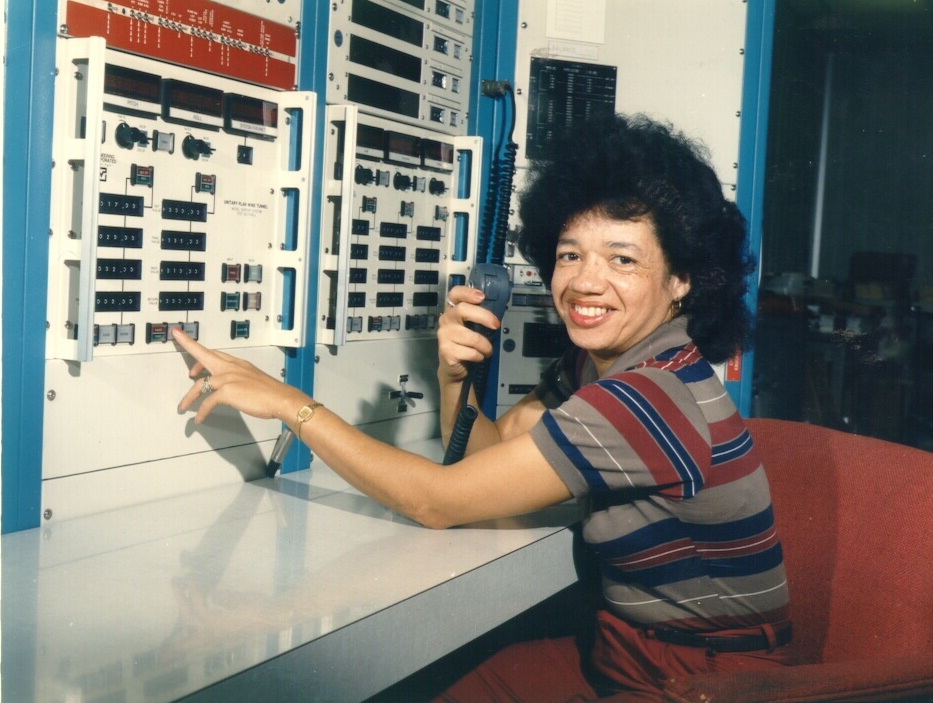
Dr. Christine Mann Darden is a mathematician, aerospace engineer, and data analyst. She is also identified as one of the Hidden Figures at the National Aeronautics and Space Administration (NASA) during the 1960s Space Race. Darden is credited with pioneering much of what is known today regarding the technology, effects, and implications of sonic booms and supersonic flights.
Early Life
Darden was born Christine Voncil Mann on September 10, 1942, in Monroe, North Carolina. She was the youngest of five children born to Desma I. Cheney and Noah Horace Mann Sr. Both Desma and Noah were college graduates who met during their time at Knoxville College, where they both trained as teachers. After moving to North Carolina, Darden’s father worked as an insurance agent for the North Carolina Mutual Life Insurance Company, and her mother worked as a school teacher. Her mother taught first through fourth grades at Winchester Avenue School, a two-room school for Black students in kindergarten through twelfth-grade, which was across the street from the family home on Fairley Avenue.
Darden’s time at Winchester began when she was only three years old and would go to work with her mother. Darden did classwork alongside the other students while in her mother’s classroom, completing the requirements for first grade at age four. The following year, she was enrolled in second grade and remained at Winchester Avenue School until tenth grade. At Winchester, Darden worked in the school library and served as an officer for her sophomore class. Darden shared that even as a young child she always liked knowing how things worked
and would routinely deconstruct her toys and reassemble them again. When she received a talking doll around age six, she took it apart to understand how it made noise. She also made brakes for her bicycle using coat hangers and pliers. She also helped her father, Noah, with landscaping and automotive maintenance throughout her childhood.
In 1956, at the beginning of her eleventh-grade year, Darden transferred from Winchester Avenue School to Allen High School in Asheville, North Carolina. Allen High School was a private, all-girls college preparatory school for non-white, minority students founded by the Methodist Church with an enrollment of about 100 students. While at Allen, Darden discovered her interest in mathematics after excelling in a geometry course. In 1958, at age fifteen, she graduated as valedictorian and was awarded a scholarship to attend the Hampton Institute in Hampton, Virginia.
Darden enrolled at the Hampton Institute in 1958 and pursued a degree in mathematics. During her time at Hampton, she participated in protests and sit-ins as part of the Civil Rights Movement of the 1960s. Beginning in February of 1960, Darden joined other Hampton students and protesters to oppose racial segregation in the United States. She marched across the Queen Street Bridge and participated in sit-ins at the Woolworth’s store in Hampton. Darden also contributed to the fight for civil rights in other ways. During the 1960 election cycle, Darden joined voter registration drives in Hampton’s Black neighborhoods around Shell Road and Rip Rap Road.
Darden graduated from the Hampton Institute in 1962 with a bachelor’s degree in mathematics education. While she originally hoped to pursue a degree in mathematics without a focus on education, her father urged her to complete her teaching certificate for job security because women were generally not employed as mathematicians and scientists during this time.
Career
After graduating from Hampton, Darden taught high school math in Portsmouth, Virginia while attending in-service classes for applied mathematics at Virginia State University (VSU) in Petersburg. Although Darden’s time as a teacher was short-lived, she was told throughout her career that her background as an educator was apparent due to her ability to explain complex technical subjects in an accessible way.
Christine Mann married Walter Lee Darden Jr., another student at VSU, in 1963. Christine also became a stepmother to Walter’s daughter, Mary, born in 1962, at this time. In 1964, the couple had a daughter of their own, Jeanne Oletia Darden (Thorton). Christine worked as a graduate research assistant during her enrollment at VSU. Her research focused on aerosol physics and air dynamics. Christine earned a Master of Science degree in Applied Mathematics in 1967. Later that year, Christine and Walter moved to Hampton, Virginia when Christine accepted a job with NASA at the Langley Research Center as a data analyst.
At NASA, Darden was among the last generation of “human computers” who performed complex numerical computations using simplistic tools such as slide rules, planimeters, paper, and pencil. Darden was one of several Black women who made history for their work as human computers at NASA, including Katherine Johnson, Mary Jackson and Dorothy Vaughan. Their work became the subject of Margot Lee Shetterly’s book Hidden Figures, which traced the women’s lives as they navigated sexual and racial discrimination at NASA from the 1930s to the 1970s. In June 1970, Walter and Christine had another child, Janet Christine Darden (Gipson).
Darden worked as a data analyst for six years. During this time, NASA staff promoted men with the same degrees to positions as engineers while passing over women like Darden. Darden advocated for a similar promotion to NASA senior staff. After some pushback, they promoted her to an aerospace engineer. Her first task was to create a computer program that could document and measure the effects of a sonic boom, which began her research on the subject. During Darden’s 30-year career in this specialty, she researched supersonic noise characterization, analysis, and reduction. She has more than fifty publications on the subject, which include Minimization of Sonic-boom Parameters in Real and Isothermal Atmospheres (1975), “Sonic-boom Theory: its Status in Prediction and Minimization” (1977), Sonic-boom Minimization with Nose-bluntness Relaxation (1979), and Status of Sonic-boom Methodology and Understanding (1988).
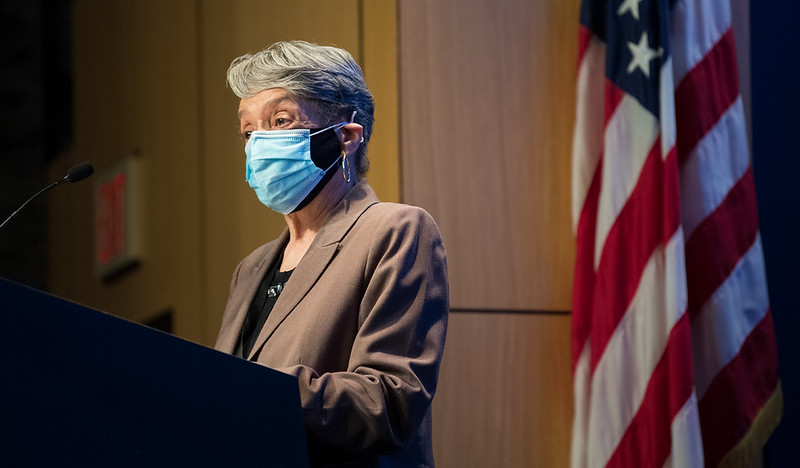
Darden also continued her education in addition to her role at NASA. She earned a Doctorate in Mechanical Engineering from George Washington University in 1983. By 1989, NASA promoted Darden to the technical leader of the Sonic Boom Group of NASA’s High Speed Research Program. Darden was the first Black woman to be promoted to a senior executive position at NASA. During her time as the technical leader, Darden studied the environmental effects of supersonic flight and created sonic-boom prediction and analysis frameworks for the airline industry. In 1999, NASA appointed Darden as the director of the Program Management Office of the Aerospace Performing Center. As director, she presided over research on air traffic management and other aeronautics programs hosted by NASA. Darden later served as the director of Langley’s Strategic Communications Office at NASA, which was her last position at NASA before retiring in 2007.
Honors and Awards
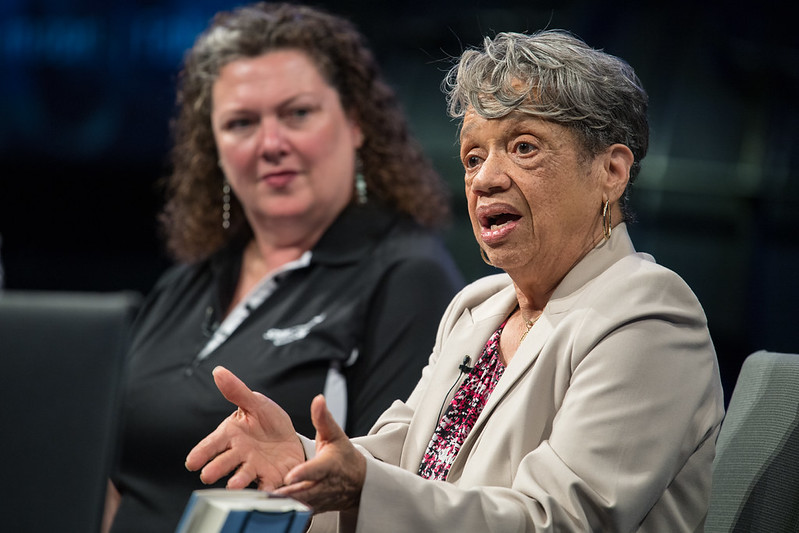
Darden has received many awards and honorary degrees in recognition of her achievements. Some of her awards include the Candace Award for Science and Technology (1987), the Black Engineer of the Year Award for Outstanding Achievement in Government (1988), the Lifetime Achievement Award from Women in Aerospace (1994), NASA’s Certificate of Outstanding Performance (which she received ten times), the NASA Outstanding Leadership Medal, and the NASA Equal Opportunity Medal. Universities have also recognized Darden’s achievements. On December 15, 2012, Old Dominion University conferred upon Darden an Honorary Doctorate Degree. On January 28, 2018, Hampton University awarded Darden the Presidential Citizenship Award for services and contributions. On December 19, 2018, NC State University awarded Darden an honorary degree. George Washington University awarded Darden an honorary degree on May 19, 2019. Virginia State University, Darden’s alma mater, also appointed her to their Board in 2020.
Darden also had the honor of receiving the Congressional Gold Medal in 2019. It is the highest civilian award issued by the United States Congress and has historically been bestowed on people who have significantly impacted United States culture and history. On November 8, 2019, H.R. 1396 was signed into public law (116-68), awarding Congressional Gold Medals to Katherine Johnson, Dorothy Vaughan, Mary Jackson, Christine Darden, and all other women who served as computer, mathematicians, and engineers... at the National Aeronautics and Space Administration (NASA) between the 1930s and the 1970s.