Some place names included in The North Carolina Gazetteer contain terms that are considered offensive.
Copyright Notice: This content is from the North Carolina Gazetteer, edited by William S. Powell and Michael Hill. Copyright © 2010 by the University of North Carolina Press. Used by permission of the publisher. For personal use and not for further distribution. Please submit permission requests for other use directly to the publisher.
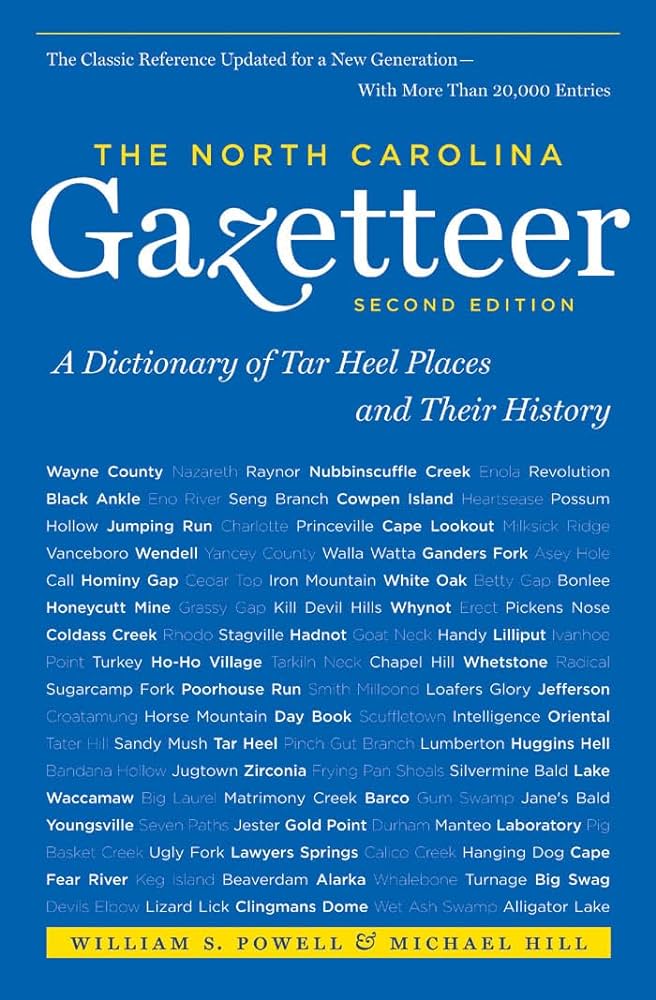
"The North Carolina Gazetteer is a geographical dictionary in which an attempt has been made to list all of the geographic features of the state in one alphabet. It is current, and it is historical as well. Many features and places that no longer exist are included; many towns and counties for which plans were made but which never materialized are also included. Some names appearing on old maps may have been imaginary, but many of them also appear in this gazetteer.
Each entry is located according to the county in which it is found. I have not felt obliged to keep entries uniform. The altitude of a place, the date of incorporation of a city or town, may appear in the beginning of one entry and at the end of another. Some entries may appear more complete than others. I have included whatever information I could find. If there is no comment on the origin or meaning of a name, it is because the information was not available. In some cases, however, resort to an unabridged dictionary may suggest the meaning of many names."
--From The North Carolina Gazetteer, 1st edition, preface by William S. Powell
| Place | Description |
|---|---|
| Turkey Swamp |
rises in S Martin County and flows S into Tranters Creek. |
| Turkey Tail |
See Glen Alpine. |
| Turkey Township |
E Sampson County. |
| Turkey-Buzzard River |
See Hyco River. |
| Turkeyfoot |
community in W Davie County. Viewed from the air or in aerial photographs, local road intersections resemble a gobbler's appendage. |
| Turkeypen Branch |
rises in NE Cherokee County and flows S into Pile Creek. |
| Turkeypen Ridge |
E Madison County at the head of West Fork [Bull Creek]. |
| Turlington |
community in E Harnett County. Slocomb Crossroads, formerly recognized as a separate community, is now a part of the Turlington community. |
| Turnagain Bay |
NE Carteret County emptying into Neuse River. Known as The Bay until about 1775. |
| Turnagain Creek |
NE Carteret County flows N to empty into Turnagain Bay. Known as The Bay Creek until around 1775. Said to have been named by Joseph Pittman, who ran an Indian out of his sweet potato patch. The Indian fled, swam the creek, and emerged on the opposite shore, where he turned to make an insulting remark to Pittman. Pittman told him to "turn again" and repeat what he had said. The Indian did, and Pittman shot him. |