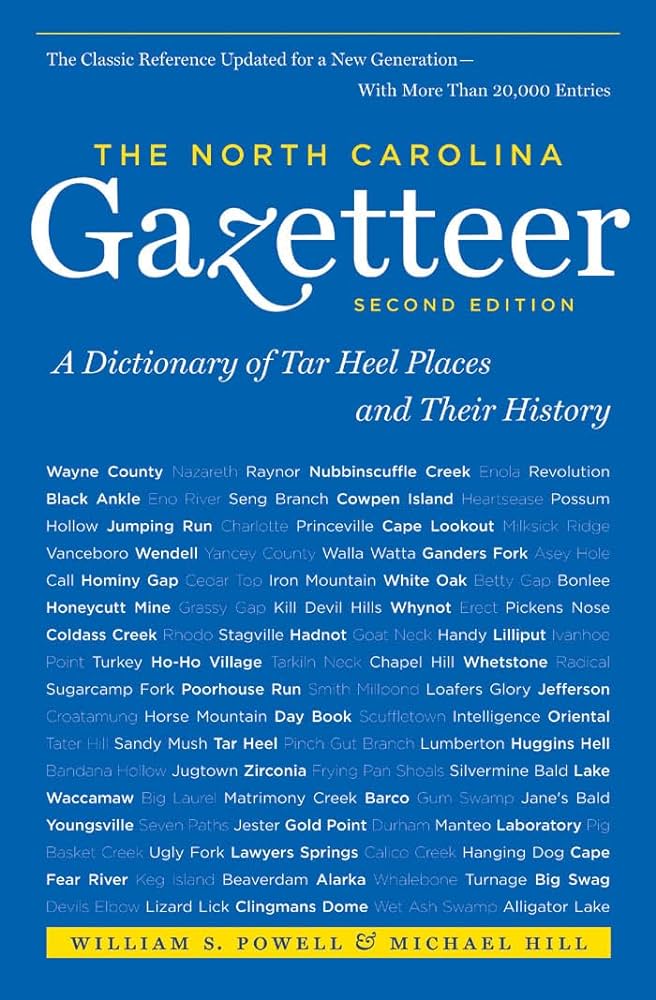
Some place names included in The North Carolina Gazetteer contain terms that are considered offensive.
Copyright Notice: This content is from the North Carolina Gazetteer, edited by William S. Powell and Michael Hill. Copyright © 2010 by the University of North Carolina Press. Used by permission of the publisher. For personal use and not for further distribution. Please submit permission requests for other use directly to the publisher.
"The North Carolina Gazetteer is a geographical dictionary in which an attempt has been made to list all of the geographic features of the state in one alphabet. It is current, and it is historical as well. Many features and places that no longer exist are included; many towns and counties for which plans were made but which never materialized are also included. Some names appearing on old maps may have been imaginary, but many of them also appear in this gazetteer.
Each entry is located according to the county in which it is found. I have not felt obliged to keep entries uniform. The altitude of a place, the date of incorporation of a city or town, may appear in the beginning of one entry and at the end of another. Some entries may appear more complete than others. I have included whatever information I could find. If there is no comment on the origin or meaning of a name, it is because the information was not available. In some cases, however, resort to an unabridged dictionary may suggest the meaning of many names."
--From The North Carolina Gazetteer, 1st edition, preface by William S. Powell
| Place | Description |
|---|---|
| Cullasaja River |
rises in SE Macon County and flows NW into Little Tennessee River. Bridal Veil, Dry, and Lower Cullasaja Falls, which see, are on the river. Moses Ashley Curtis, writing from Franklin on September 2, 1829, said that the "Falls of Sugar Town Creek" are "very imposing—nearly as high as Linville." |
| Culler |
See Pinnacle. |
| Cullie Creek |
rises in N central Carteret County and flows NW into Cedar Creek. It is a very short stream. |
| Cullowhee |
community in W central Jackson County on Tuckasegee River. Originally named Kullaughee Valley, an Indian word meaning "place of the lilies." Name changed to Painter, for the first postmaster, when a post office was est. there in 1883 (closed 1908). Renamed Cullowhee about 1900. Home of Western Carolina University, founded in 1889. Alt. 2,066. |
| Cullowhee Creek |
rises in W Jackson County and flows N into Tuckasegee River. |
| Cullowhee Gap |
on the Jackson-Macon county line. |
| Cullowhee Mountain |
W Jackson County, extends N from Hunter Jim Creek to Webster Creek. Alt. 4,411. |
| Cullowhee Township |
W central Jackson County. |
| Cumberland |
town in W Cumberland County. Settled 1850. Known as Beaver Creek for the stream on which it is located until 1889, when it was inc. Long inactive in municipal affairs. Alt. 125. |
| Cumberland County |
was formed in 1754 from Bladen County. Located in the SE section of the state, it is bounded by Sampson, Bladen, Robeson, Hoke, Harnett, and Moore Counties. It was named for William Augustus, Duke of Cumberland (1721-65), second son of George II, who was commander of English troops at the Battle of Culloden in 1746 in which Scottish Highlanders were defeated. His extreme severity earned him the nickname of "The Butcher." It is ironic that the county named for him should have been settled by Scottish Highlanders. Area: 662 sq. mi. County seat: Fayetteville, with an elevation of 107 ft. Townships are Beaver Dam, Black River, Carvers Creek, Cedar Creek, Cross Creek, Eastover, Grays Creek, Manchester, Pearces Mill, Rockfish, and Seventy-First. Produces tobacco, corn, soybeans, wheat, oats, cotton, poultry, bakery products, textiles, dairy products, machinery, and lumber. See also Fayette County; Choffington. |