Some place names included in The North Carolina Gazetteer contain terms that are considered offensive.
Copyright Notice: This content is from the North Carolina Gazetteer, edited by William S. Powell and Michael Hill. Copyright © 2010 by the University of North Carolina Press. Used by permission of the publisher. For personal use and not for further distribution. Please submit permission requests for other use directly to the publisher.
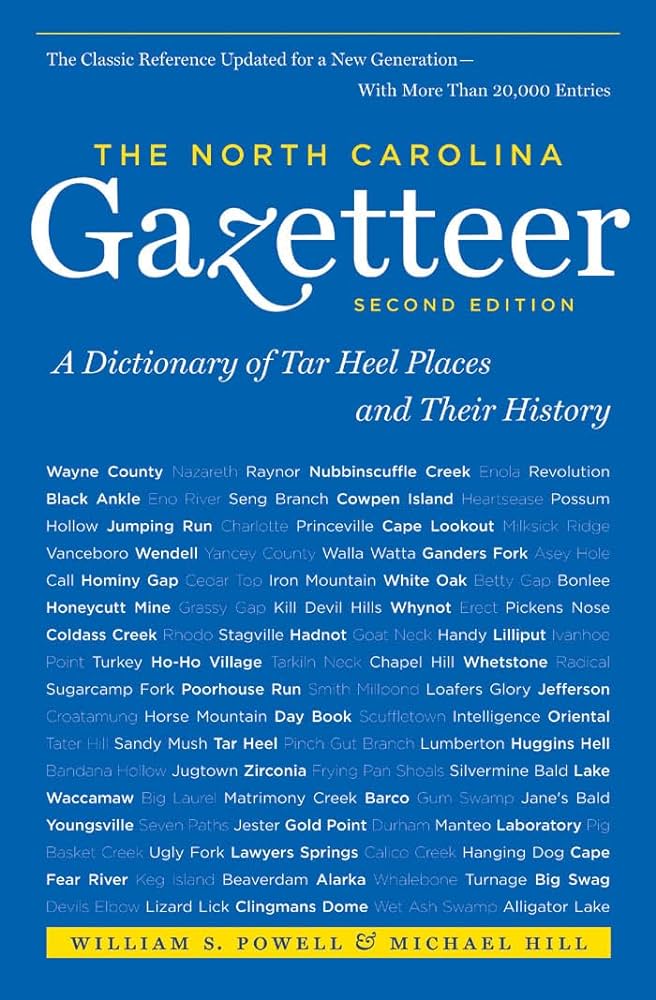
"The North Carolina Gazetteer is a geographical dictionary in which an attempt has been made to list all of the geographic features of the state in one alphabet. It is current, and it is historical as well. Many features and places that no longer exist are included; many towns and counties for which plans were made but which never materialized are also included. Some names appearing on old maps may have been imaginary, but many of them also appear in this gazetteer.
Each entry is located according to the county in which it is found. I have not felt obliged to keep entries uniform. The altitude of a place, the date of incorporation of a city or town, may appear in the beginning of one entry and at the end of another. Some entries may appear more complete than others. I have included whatever information I could find. If there is no comment on the origin or meaning of a name, it is because the information was not available. In some cases, however, resort to an unabridged dictionary may suggest the meaning of many names."
--From The North Carolina Gazetteer, 1st edition, preface by William S. Powell
| Place | Description |
|---|---|
| High Point |
S peak of Deaver View Mountain in central Buncombe County. |
| High Point |
peak in W Jackson County between Nation Creek and Rocky Branch. |
| High Point |
city in SW Guilford County. Alt. 940. Laid out in 1853 and inc. 1859. Named for the fact that it was the highest point on the North Carolina Railroad. Produces textiles, hosiery, furniture, baked goods, apparel, corrugated boxes, fabricated metals, toys, lumber, and chemicals. Furniture market is operated there. Home of High Point University. See also Browntown. |
| High Point Lake |
SW Guilford County, is formed at the junction of East Fork Deep River and West Fork Deep River where Deep River is formed. The lake was created by a dam constructed in 1928 and is named for and owned by the city of High Point. Max. depth 20 ft.; area 150 acres. |
| High Point Township |
SW Guilford County. Named for the town. |
| High Ridge |
W Madison County between Davis Branch and Murray Branch. |
| High Rock |
mountain in central Madison County between Hunter Creek and Brush Creek at the N end of High Rock Ridge. Alt. 3,555. |
| High Rock |
community in S Davidson County on Yadkin River. Alt. 584. |
| High Rock |
former community and post office in SE Rockingham County on Haw River. Mentioned in local records as early as 1754; mill operated there from as early as 1753 until the 1920s, when the dam was broken. Gov. William Tryon camped there, 1771; Generals Cornwallis and Greene camped there during the Revolutionary War. The name survives as applied to a local farm and brick house built about 1807. |
| High Rock Creek |
See Herbin's Creek. |