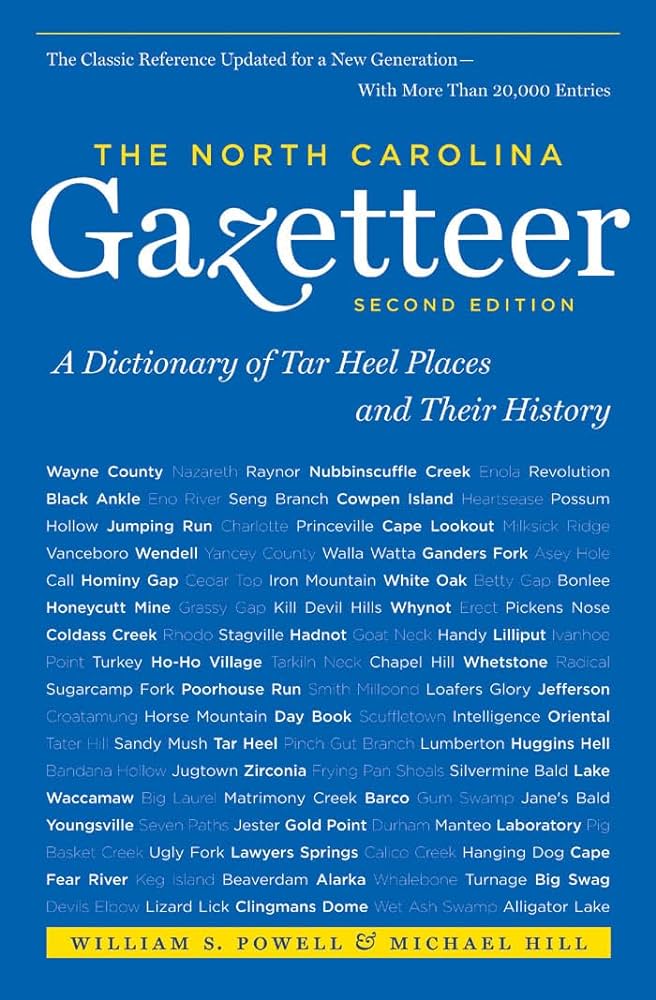
Some place names included in The North Carolina Gazetteer contain terms that are considered offensive.
Copyright Notice: This content is from the North Carolina Gazetteer, edited by William S. Powell and Michael Hill. Copyright © 2010 by the University of North Carolina Press. Used by permission of the publisher. For personal use and not for further distribution. Please submit permission requests for other use directly to the publisher.
"The North Carolina Gazetteer is a geographical dictionary in which an attempt has been made to list all of the geographic features of the state in one alphabet. It is current, and it is historical as well. Many features and places that no longer exist are included; many towns and counties for which plans were made but which never materialized are also included. Some names appearing on old maps may have been imaginary, but many of them also appear in this gazetteer.
Each entry is located according to the county in which it is found. I have not felt obliged to keep entries uniform. The altitude of a place, the date of incorporation of a city or town, may appear in the beginning of one entry and at the end of another. Some entries may appear more complete than others. I have included whatever information I could find. If there is no comment on the origin or meaning of a name, it is because the information was not available. In some cases, however, resort to an unabridged dictionary may suggest the meaning of many names."
--From The North Carolina Gazetteer, 1st edition, preface by William S. Powell
| Place | Description |
|---|---|
| Nick Gap |
central Haywood County on the head of Messer Branch. |
| Nickajack Creek |
rises in E Macon County and flows NE into Cullasaja River. |
| Nickajack Gap |
at the head of Nickajack Creek in E Macon County. |
| Nicks Creek |
rises in S McDowell County and flows NE into Catawba River. |
| Nicks Knob |
S Cherokee County near the headwaters of Moccasin Creek. |
| Nigh Inlet |
a point of land on Ocracoke Island about 3½ mi. from the S end of the island, SE Hyde County. The inlet may be the site of Port Grenvil, which see, shown on the White map, 1590, but long closed. |
| Nikwasi |
See Franklin. |
| Nile |
community in N Alleghany County served by post office, 1898-1915. |
| Nimrod |
community in SW Mecklenburg County served by post office, 1891-1902. Was on the W side of the Charlotte, Columbia, and Augusta Railroad. Site is now the Yorkmont area of Charlotte. |
| Nims |
formerly a community in E Gaston County but now a part of the town of Mount Holly, which see. |