See also: Poe, Clarence Hamilton; Polk, Leonidas LaFayette
The Progressive Farmer is among the oldest and most widely read of the nation's agricultural periodicals. The history of the publication reflects dramatic changes in southern rural life and journalism. The paper was founded in Winston (now Winston-Salem) in February 1886 by Leonidas L. Polk, a former Confederate officer and North Carolina commissioner of agriculture. Initially, it appeared in a weekly newspaper format. The Progressive Farmer promoted more efficient agricultural practices and improved farm life. Polk also used the paper to stimulate organization among farmers, in particular the Farmers' Alliance and Industrial Union, or Southern Farmers' Alliance, for which the paper served as the official state organ.
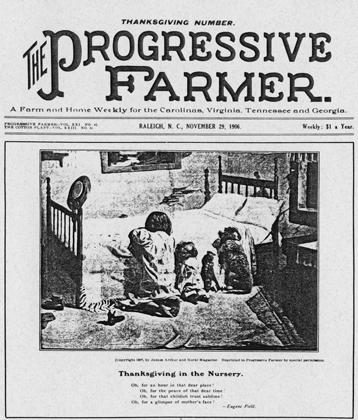
After Polk moved his publishing enterprise to West Hargett Street in Raleigh in 1887, the Progressive Farmer was increasingly involved in political controversy. In the late 1880s and early 1890s the paper championed a wide range of reform causes, including the establishment of an agricultural college in Raleigh, railroad rate regulation, and the Subtreasury Plan. Although its editorials first maintained that these reforms could be achieved through legislation supported by the Democratic Party, just before Polk's sudden death in June 1892 the Progressive Farmer announced its endorsement of the newly formed People's, or Populist, Party. At that time, the circulation of the paper exceeded 20,000, making it one of the leading Farmers' Alliance-Populist papers in the nation.
After Polk's death, editorial control of the Progressive Farmer passed to James L. Ramsey. Ownership of the company remained in the hands of Polk's daughter, Juanita Polk Denmark, whose husband, James W. Denmark, was business manager. Ramsey's tenure, which lasted until 1899, was shaped by the turbulence of Populism, Fusion, and Democratic white supremacy politics. During the 1890s the paper continued to portray itself as the friend of farmers. It endorsed all of the Populist platforms and supported Populist-Republican candidates. In 1896, the newspaper supported the Democratic-Populist nominee for president, William Jennings Bryan.
The demise of Populism required a new political and journalistic strategy. This different direction was conceived and executed by Clarence H. Poe (1881–1964), a native of Chatham County. Although only 18 years old, Poe became editor-in-chief of the Progressive Farmer in July 1899. Poe had written for the newspaper since 1897, and he was deeply interested in rural problems. Poe had been approved for the editorship by the Denmarks and by Ramsey. Yet Poe was not committed to third-party politics. He immediately made peace with North Carolina Democrats, disengaged the Progressive Farmer from Populism, and supported the Democrats' disfranchisement legislation of 1900.
In 1903, with the help of borrowed money, Poe completed the transition by purchasing Polk's Progressive Farmer Company for slightly more than $7,000. He then formed a new company with the same name, buying almost 47 percent of the stock. The other owners of the new Progressive Farmer were B. W. Kilgore, later dean of agriculture at North Carolina State College (modern-day North Carolina State University); Charles W. Burkett, then head of the Agriculture Department at the School; T. B. Parker, a prominent member of the North Carolina Farmers' Alliance; and the Baptist editor Josiah W. Bailey of Raleigh. Impressed by the failures of Populism, Poe declared that the new Progressive Farmer would be free from "all partisan politics and political scheming" but would remain dedicated to "everything that makes for the uplift or betterment of farm life." This strategy, as well as high-quality writing and production, proved an immediate success. Subscriptions grew from 6,000 in 1903 to more than 35,000 by 1908.
Poe served as president of the Progressive Farmer until 1954. Under his leadership the publication experienced continued transformations. Growth in readership was exponential, reaching well over 1 million by the mid-1950s. But because of its aggressive search for new subscribers, the publication's primary connection with North Carolina deteriorated. An increasingly regional focus and mergers with rural papers from outside North Carolina resulted in a decision to establish a centrally located printing plant in Birmingham, Alabama, in 1911. Proximity to Birmingham allowed for regional offices to later be added in Memphis and Dallas. The regional system permitted local editions with attention to different agricultural conditions and zones. While editions and logistics of publication were sorted regionally, Poe directed its operations from his Raleigh office until January 1954, after which he served as senior editor and board chairman until his death in 1964. Mastheads of the magazine list Raleigh as the principal administrative office until about 1917. By 1919, the Raleigh office became the heart of the Progressive Farmer Eastern Edition for The Carolinas, Virginia, Georgia and Florida. In editions after, it is listed among the other regional offices like Memphis, Dallas, and Birmingham.
Between 1903 and 1930, fourteen other farm papers were bought or merged into Progressive Farmer; its circulation expanded from 5,000 to 1,400,000, and Progressive Farmer became the dominant farm publication in the South and one of the strongest in the United States. In 1932, the weekly newspaper format was dropped in favor of a monthly magazine with color illustrations. Corporate business filings for the The Progressive Farmer Co. at this time also listed the principal address of the magazine at 119 W Hargett St. in Raleigh.
Although generally directed to self-help and private forms of improvement, Poe's Progressive Farmer endorsed many causes, including better rural health, improved farm roads, equal railroad freight rates for the South, mechanization of farms, and better public education. Poe also used the Progressive Farmer to promote rural racial segregation. Unlike the first Progressive Farmer, however, the Progressive Farmer of the twentieth century steadfastly kept Poe's initial promise by supporting agricultural programs within the context of Democratic political control.
By the early 2000s, the Progressive Farmer reached more than 1.5 million readers 20 times a year.
Issues of the Progressive Farmer from 1886 to 1904 can be viewed online at the Library of Congress Chronicling America: http://chroniclingamerica.loc.gov/lccn/sn92073049/issues/